
By Theresa Moses
As Nigeria moves towards the 2027 general elections, a media-tracking report has raised concerns over the prominence of personality attacks in political discourse, including discussions on issues affecting the country’s development.
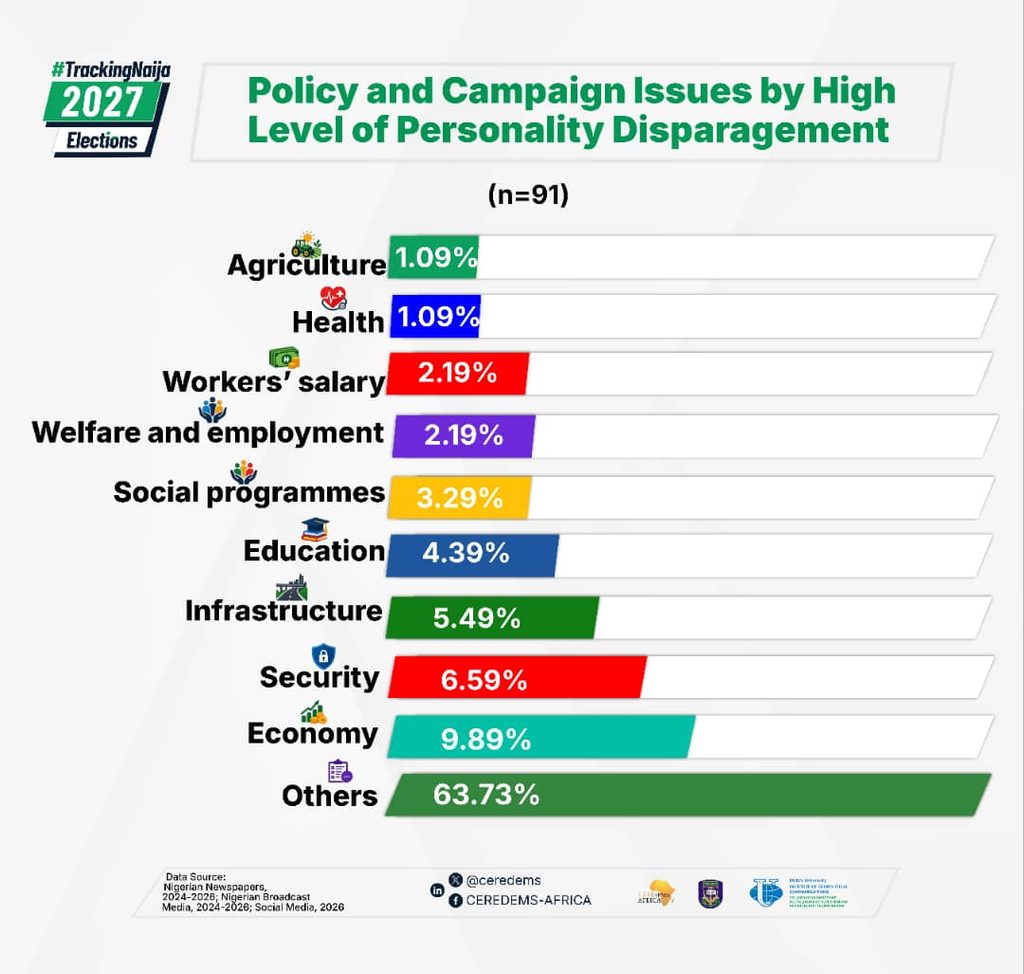
The report, which examined policy and campaign issues associated with high levels of personality disparagement, found that the category labelled “Others” accounted for 63.73 per cent of the 91 observations analysed.
However, the data also recorded personality disparagement across discussions on the economy, security, infrastructure, education and other policy areas, raising questions about the quality of political debate ahead of the elections.

According to the findings, the economy accounted for 9.89 per cent of the observations, followed by security at 6.59 per cent and infrastructure at 5.49 per cent.
Education represented 4.39 per cent, while social programmes accounted for 3.29 per cent. Welfare and employment, as well as workers’ salaries, each recorded 2.19 per cent.
Health and agriculture each accounted for 1.09 per cent.
The presence of personality disparagement in discussions on the economy, security and infrastructure is particularly noteworthy, given the importance of these issues to national development and voters’ assessment of political leadership.
The report’s analysts cautioned that personal attacks in debates on matters of public interest could distract from substantive discussions and make it more difficult for citizens to assess competing policy positions.
“Deploying personality disparagement while discussing issues of national importance may blur the public’s understanding of the essence of these issues and undermine their right to know,” the report noted.
The findings highlight the importance of examining not only the issues dominating political discussions but also how political actors and other stakeholders communicate about them.
As political activities intensify ahead of the 2027 polls, the quality of public debate will remain an important consideration for voters, political parties, candidates and the media.
Discussions about economic management, insecurity, employment, education, healthcare and infrastructure provide opportunities for political stakeholders to explain their policies, defend their records and present alternatives.
Where personal attacks overshadow such discussions, voters may find it more difficult to distinguish policy arguments from attempts to discredit political opponents.
The findings, however, should be interpreted within the limits of the tracking exercise. The sample of 91 observations does not, on its own, establish the overall prevalence of personality attacks across Nigeria’s entire political space or prove their effect on voter behaviour.
The data was drawn from Nigerian newspapers between 2024 and 2026, Nigerian broadcast media between 2024 and 2026, and social media content from 2026.
The analysis was conducted under the TrackingNaija2027Elections project, a collaborative initiative by CEREDEMS-AFRICA, the University of Ilorin, and the RUDN University Institute of Geopolitical Communications.
GATMASH NEWS
…News That Drives Impact
For advert placements and business inquiries, kindly reach us via:
📧 Email: [email protected]
📞 Tel/WhatsApp: +234 (0) 807 202 2024
We value your voice! Share your stories, eyewitness reports, and contributions with us anytime:
📲 SMS/WhatsApp: +234 (0) 807 202 2024
📧 Email: [email protected]
Visit us online: https://gatmash.com