
By: Theresa Moses
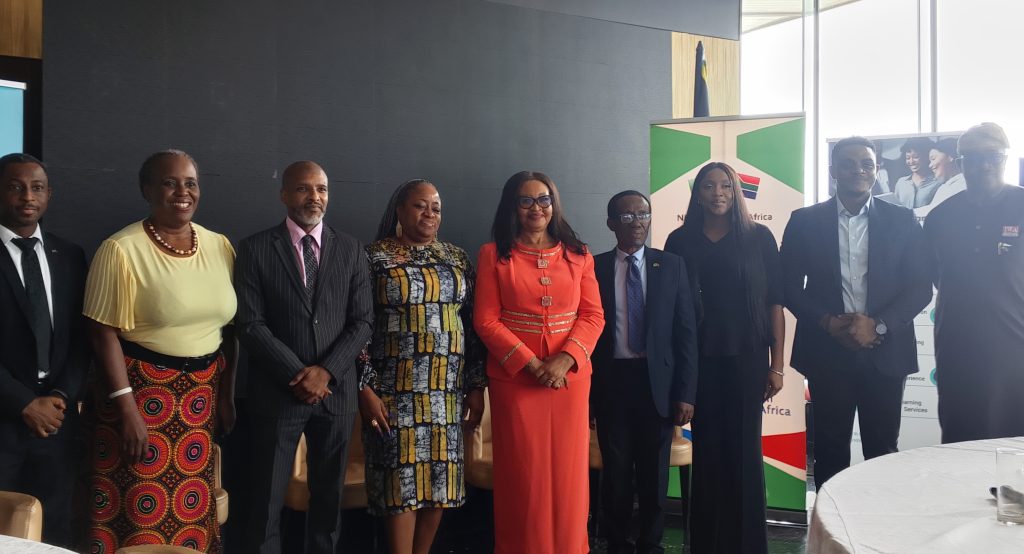
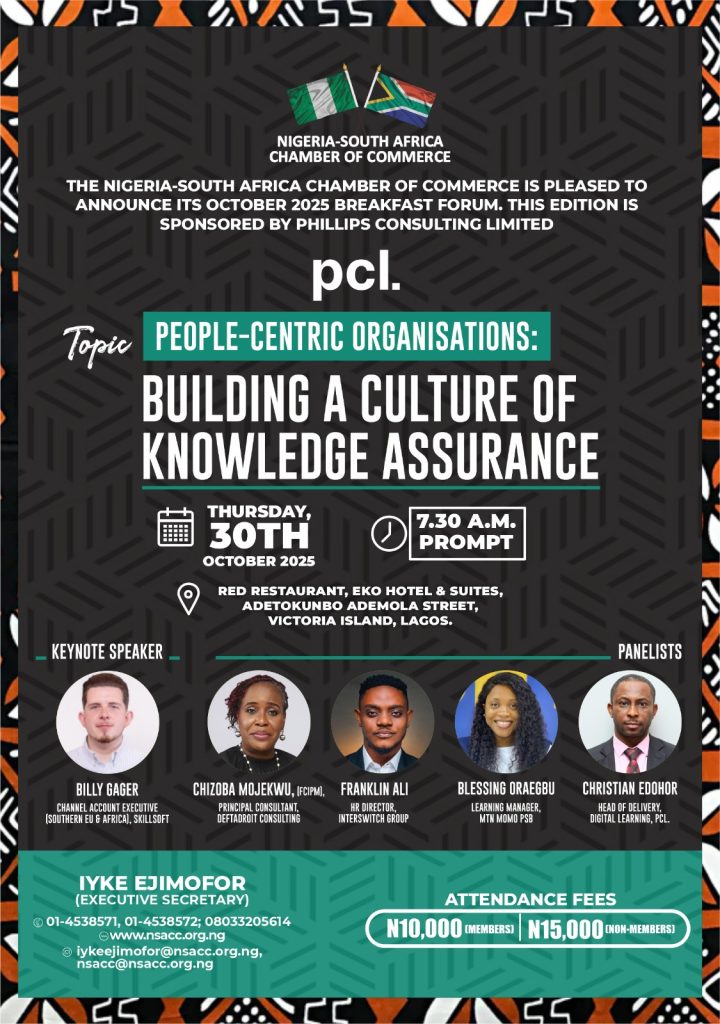
The Nigeria–South Africa Chamber of Commerce (NSACC) held its October 2025 Breakfast Forum on Thursday, October 30, 2025, at the Red Restaurant, Eko Hotel & Suites, Victoria Island, Lagos, drawing together top business executives, HR professionals, and digital transformation experts to explore the theme: “People-Centric Organisations: Building a Culture of Knowledge Assurance.”
The high-level forum, sponsored by Phillips Consulting Limited (PCL), created a vibrant atmosphere for the exchange of ideas on how organisations can leverage human capital and technology to build sustainable, knowledge-driven work cultures in Africa’s evolving business landscape.
In her opening remarks, Dr. (Mrs.) Ije Jidenma, Chairperson of the NSACC, expressed gratitude to members for their unwavering commitment and consistency in driving the chamber’s vision. She also commended Phillips Consulting—now rebranded as PCL—for its pioneering contributions to business excellence and for sponsoring the October edition of the Breakfast Forum.

She recalled the firm’s transformation from the late 1990s and its growth into a force within Africa’s consulting ecosystem, adding that the collaboration between Nigeria and South Africa remains vital to the continent’s development.
“The true differentiator for any organisation is no longer its products or processes, but its people and the collective intelligence they bring together,” Dr. Jidenma stated.
“Knowledge assurance challenges us to create environments where learning is continuous, where experience is captured and shared, and where people feel empowered to contribute their best ideas.”
She stressed that collaboration, inclusivity, and trust remain the foundations of resilient organisations and expressed optimism that if Nigeria and South Africa succeed in strengthening institutional and economic ties, the African continent will be on the right path to shared prosperity.
Delivering the keynote virtually, Bibi Gager, Channel Account Executive for Southern EU and Africa at Skillsoft, gave an inspiring and data-driven presentation on how organisations can institutionalise knowledge assurance—a systematic process of ensuring that critical knowledge is captured, retained, and applied across all levels.
“Too often, when the most experienced person leaves the room, institutional memory vanishes,” Gager said.
“Knowledge assurance ensures that when people leave, knowledge stays.”
He explained that by leveraging artificial intelligence, analytics, and personalised learning pathways, digital platforms such as Skillsoft’s Percipio can improve retention, enhance skill development, and ensure knowledge continuity.
Gager described knowledge assurance as a business imperative, not a mere HR initiative.
“Knowledge is the only asset that grows when shared,” he concluded. “Compliance checks boxes, but culture changes behaviour.”
A panel of distinguished professionals expanded on the keynote theme, sharing practical insights and real-world case studies on embedding people-centric values in the workplace.
Chizoba Mojekwu, Principal Consultant, Deftadroit Consulting and former HR leader at the Central Bank of Nigeria (CBN), drew from her experience implementing digital learning transformation through Skillsoft’s Percipio platform. She highlighted the importance of humility, empathy, and inclusion in leadership.
“Every employee comes with unique gifts and value,” Mojekwu said. “Digital learning helped us democratise learning and ensure that women and younger employees could access opportunities equally.”
She described how the CBN overcame resistance to e-learning through strong leadership commitment, gamified learning, and internal champions.
“We had to prove that learning was not about travel or perks—it was about growth, inclusion, and sustainability,” she added.
Blessing Oraegbu, Learning Manager, MTN MoMo PSB, shared her personal journey in HR and how organizations have evolved from “hire and fire” entities to strategic, people-driven ecosystems.
She identified clarity, collaboration, and capability building as the three pillars of operational excellence.
“When people understand why they are here, collaborate effectively, and know the organisation means well for them, performance naturally improves,” she stated.
Christian Edohor, Head of Delivery, Digital Learning, PCL, spoke on the power of digital learning platforms in capturing and disseminating institutional knowledge. He introduced the concept of bespoke content digitisation, which enables organisations to convert internal processes and expertise into interactive learning materials.
“When leaders embrace digital learning, the rest of the organisation follows,” he said, while acknowledging that adoption resistance remains a major challenge.
Franklin Ali, HR Director, Interswitch Group, gave a bold and reflective contribution on the link between leadership, learning, and organisational capability.
“We don’t have a knowledge shortage; we have a learning crisis,” he declared. “The proof of learning is in problem-solving.”
Ali detailed Interswitch’s innovative approach to knowledge retention, which includes leadership readiness assessments, job rotations, and acting capacity models that allow employees to gain hands-on experience before assuming full leadership roles.
“Capability is the new workplace currency,” he concluded. “The more skilled you are, the higher your value.”
The interactive question-and-answer session made the event even more engaging and memorable.
Participants posed thought-provoking questions, shared personal experiences, and exchanged ideas with the panelists on how to align digital transformation with people empowerment.
The lively exchange brought the discussions to life, reinforcing the key message that knowledge assurance must be embedded, not imposed—a living culture that thrives on shared wisdom, collaboration, and innovation.
The NSACC continues to serve as a bridge for bilateral cooperation, investment, and thought leadership between Nigeria and South Africa, with a mission to foster innovation, inclusivity, and shared prosperity across Africa.