
By Theresa Moses
As Nigeria moves towards the 2027 general elections, women’s political inclusion is receiving attention in the media—but much of that conversation remains centred on promises of inclusion rather than the women who will actually contest elections, secure party nominations or occupy positions of political leadership.
New monitoring data from the #TrackingNaija2027Elections initiative shows a significant imbalance in the way women and the electoral process are being discussed. While party inclusion dominates the conversation, issues that would provide evidence of whether women are gaining meaningful political space—including the number of female candidates, their access to leadership positions, harassment and other barriers to participation—remain largely underreported.
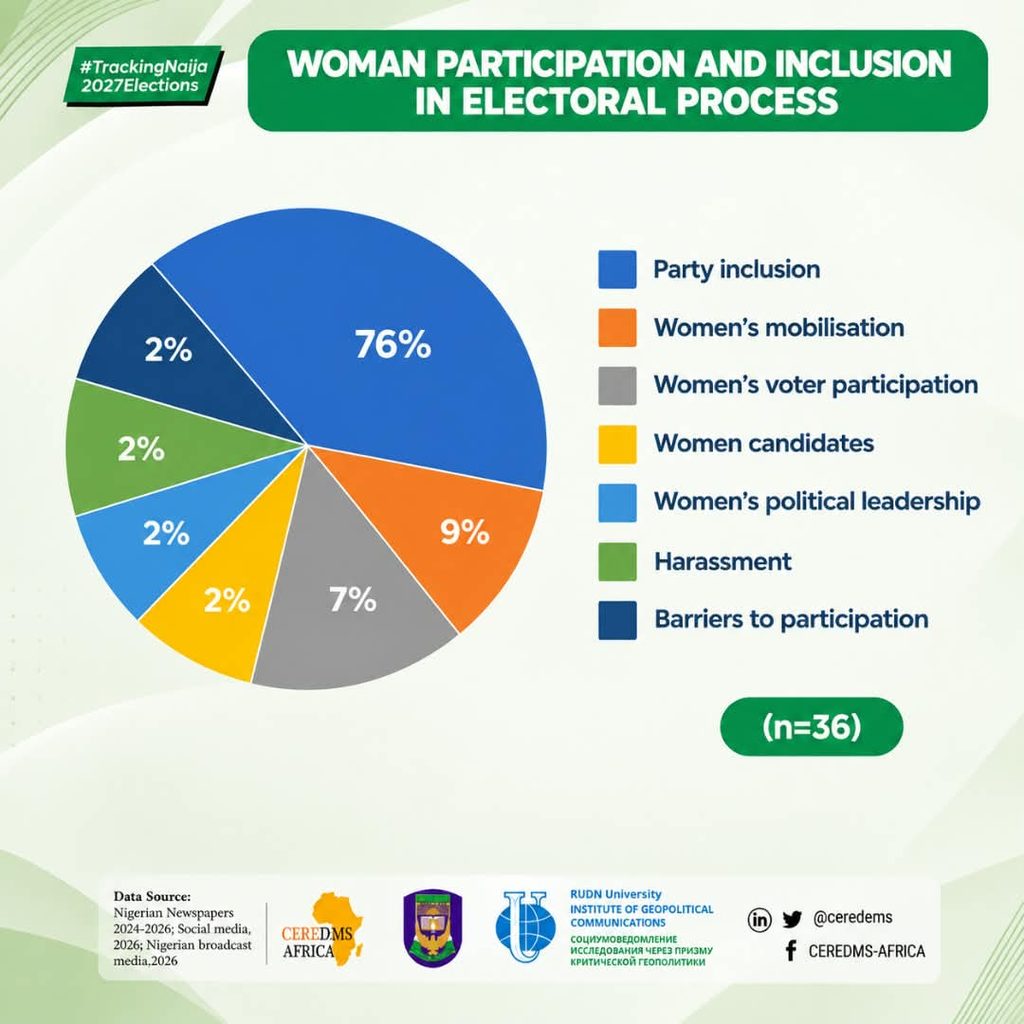
An analysis of 36 monitored observations found that party inclusion accounted for 76 per cent of coverage relating to women and the electoral process. Women’s mobilisation represented 9 per cent, while women’s voter participation accounted for 7 per cent.

In contrast, women candidates, women’s political leadership, harassment and barriers to participation each accounted for only 2 per cent.
The figures point to a gap between the language of political inclusion and the practical indicators needed to determine whether that inclusion is translating into representation.
The monitoring covers Nigerian newspapers from 2024 to 2026, alongside social media and broadcast media monitored in 2026. Its findings provide an early picture of the issues receiving public attention as political parties and other stakeholders prepare for the 2027 elections.
The missing numbers
For gender inclusion to move beyond rhetoric, several questions will become increasingly important as the election cycle progresses.
How many women are seeking party nominations? How many will emerge as candidates? How many are contesting constituency and executive positions? How many women occupy influential positions within political parties? What happens to women who lose nominations, withdraw from contests or face intimidation?
The monitoring data suggests that these questions have yet to receive comparable media attention.
The report observes that the concentration on commitments to inclusion may leave the public with insufficient information about actual political participation.
That distinction matters because a party announcing an intention to promote women does not, by itself, establish how many women will eventually appear on the ballot. Similarly, participation as voters or campaign supporters is different from having women represented among candidates and decision-makers.
The limited attention to harassment and barriers is also significant. Political participation is affected not only by whether women are formally allowed to contest but also by the conditions under which they participate.
Tracking those experiences would provide a clearer picture of whether women are entering the political arena on equal terms or encountering obstacles that may discourage participation.
With the 2027 electoral cycle approaching, sustained reporting on nominations, party structures, campaign environments and documented cases of intimidation could therefore become an important part of assessing the country’s progress on political inclusion.
Civil society’s role is expanding
The monitoring exercise also examined the activities of civil society organisations across the electoral cycle.
Its findings show that civil society engagement extends considerably beyond traditional election observation.
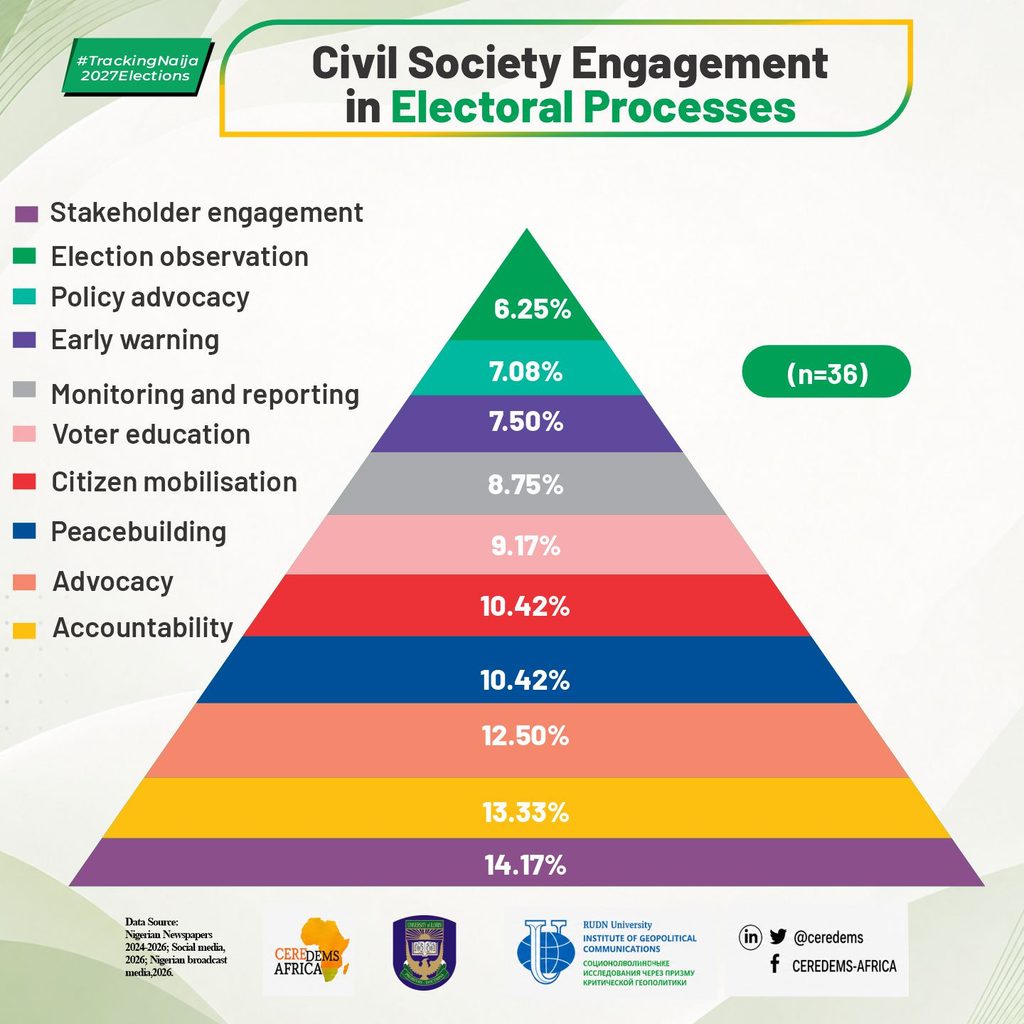
Of 36 monitored observations, stakeholder engagement accounted for 14.17 per cent, followed by accountability at 13.33 per cent and advocacy at 12.50 per cent.
Peacebuilding and citizen mobilisation each accounted for 10.42 per cent, while voter education represented 9.17 per cent.
Monitoring and reporting accounted for 8.75 per cent, early warning 7.50 per cent, policy advocacy 7.08 per cent and election observation 6.25 per cent.
The distribution reflects a broader understanding of what is required to support credible elections.
Election observation remains important, but it is only one part of the electoral process. Stakeholder engagement can bring political parties, election officials, civil society groups, communities and other actors into dialogue. Accountability mechanisms can draw attention to institutional performance, while advocacy seeks changes in policies and practices.
Peacebuilding and early-warning initiatives are particularly relevant in an environment where political competition can generate tensions before, during and after elections.
Citizen mobilisation and voter education also help connect electoral processes with the people expected to participate in them.
Taken together, the figures indicate that civil society organisations are increasingly engaging with elections as a continuous democratic process rather than an event that begins and ends on polling day.
The bigger question comes after the votes
The monitoring initiative also looked beyond the immediate electoral period to identify factors that could influence democratic stability after the 2027 elections.
Unlike the women and civil society datasets, this analysis was based on a much larger sample of 2,819 observations.
The leading themes were democratic norms, at 16.99 per cent; political stability, 15.89 per cent; constitutional order, 14.30 per cent; and institutional legitimacy, 13.48 per cent.
Lessons for future elections accounted for 12.42 per cent, followed by public trust at 8.09 per cent and political tolerance at 6.67 per cent.
Opposition behaviour represented 5.68 per cent, while peaceful transfer of power accounted for 3.90 per cent and acceptance of electoral outcomes 2.59 per cent.
The distribution highlights the importance of what happens after the declaration of results.

Elections do not automatically strengthen democracy simply because voting has taken place. The post-election period can determine whether institutions retain public confidence, whether political disagreements are managed within established rules and whether competing actors accept lawful mechanisms for resolving disputes.
Political parties and candidates have established legal avenues to challenge electoral processes where they believe violations have occurred. The ability of institutions to process such disputes through constitutional and legal mechanisms is therefore central to maintaining confidence in the system.
At the same time, the conduct of political actors after an election can influence the wider political environment.
How winners engage opponents, how opposition parties respond to defeat, how institutions handle disputes and whether competing interests respect constitutional procedures can all affect political stability.
The relatively low share of monitoring attention devoted specifically to acceptance of electoral outcomes and peaceful transfer of power does not necessarily mean these issues are unimportant. Rather, it highlights areas that warrant continued observation as the election approaches and particularly during the transition period afterwards.
Beyond Election Day
The #TrackingNaija2027Elections initiative, coordinated by CEREDEMS-Africa and its partners, uses a 300-member volunteer network to monitor several dimensions of Nigeria’s electoral environment.
Its areas of focus include electoral governance, security, justice and peace, information integrity, artificial intelligence and elections, and inclusive participation.
The breadth of the monitoring reflects the changing nature of electoral politics.
Campaigns are no longer fought only through rallies, posters and traditional media. Political communication now moves rapidly across social media platforms, while artificial intelligence and digital technologies create new opportunities as well as new risks for political communication and information integrity.
At the same time, questions of security, justice, inclusion and institutional credibility remain central to whether citizens can participate meaningfully.
The gender findings fit into this wider picture. If women are to have a meaningful presence in the 2027 political process, public scrutiny will need to move beyond general commitments and examine measurable outcomes.
That means documenting nominations, candidates, party leadership positions, campaign participation, barriers, harassment and other factors that shape women’s ability to compete.
It also means distinguishing between different forms of participation. A woman participating as a voter, campaign volunteer or mobiliser occupies a different position from a woman seeking a party ticket or contesting for elected office.
Understanding those distinctions would give voters, journalists, civil society organisations and election stakeholders a more complete picture of women’s political participation.
Turning inclusion into evidence
The emerging monitoring picture does not suggest that the language of inclusion is unimportant. Rather, it raises the question of what should follow the promises.
For political parties, that could mean greater public visibility around the number and proportion of women receiving nominations and occupying decision-making positions.
For election stakeholders, it could mean systematically documenting barriers and reported incidents affecting female aspirants and candidates.
For the media, it could mean moving beyond statements about women’s inclusion to sustained reporting on what happens within party structures and during campaigns.
For civil society organisations, the data provides another basis for tracking whether advocacy translates into measurable changes in participation and representation.
And for citizens, access to such information would make it easier to distinguish between stated commitments and observable outcomes.
Nigeria’s 2027 elections will therefore be about more than the eventual results. They will also test how effectively political institutions accommodate participation, how political actors manage competition and how democratic institutions respond when disagreements arise.
The #TrackingNaija2027Elections findings offer an early indication of where public attention is concentrated, and where important questions remain less visible.
The conversation about women and politics has clearly entered the electoral agenda. The next stage is to establish, with evidence, whether women are actually moving from the margins of political participation into the rooms where nominations, policies and political decisions are made.
Likewise, the broader democratic test will continue after the ballots are counted: whether institutions retain legitimacy, whether political actors respect constitutional processes, whether disagreements are resolved through lawful channels and whether citizens continue to trust the democratic system.
For Nigeria, the 2027 election cycle will therefore provide not only an opportunity to measure participation at the ballot box, but also to examine the quality of the political process surrounding it; from inclusion and representation to accountability, institutional legitimacy and the management of the post-election transition.
GATMASH NEWS
…News That Drives Impact
For advert placements and business inquiries, kindly reach us via:
📧 Email: [email protected]
📞 Tel/WhatsApp: +234 (0) 807 202 2024
We value your voice! Share your stories, eyewitness reports, and contributions with us anytime:
📲 SMS/WhatsApp: +234 (0) 807 202 2024
📧 Email: [email protected]
Visit us online: https://gatmash.com