
By Theresa Moses
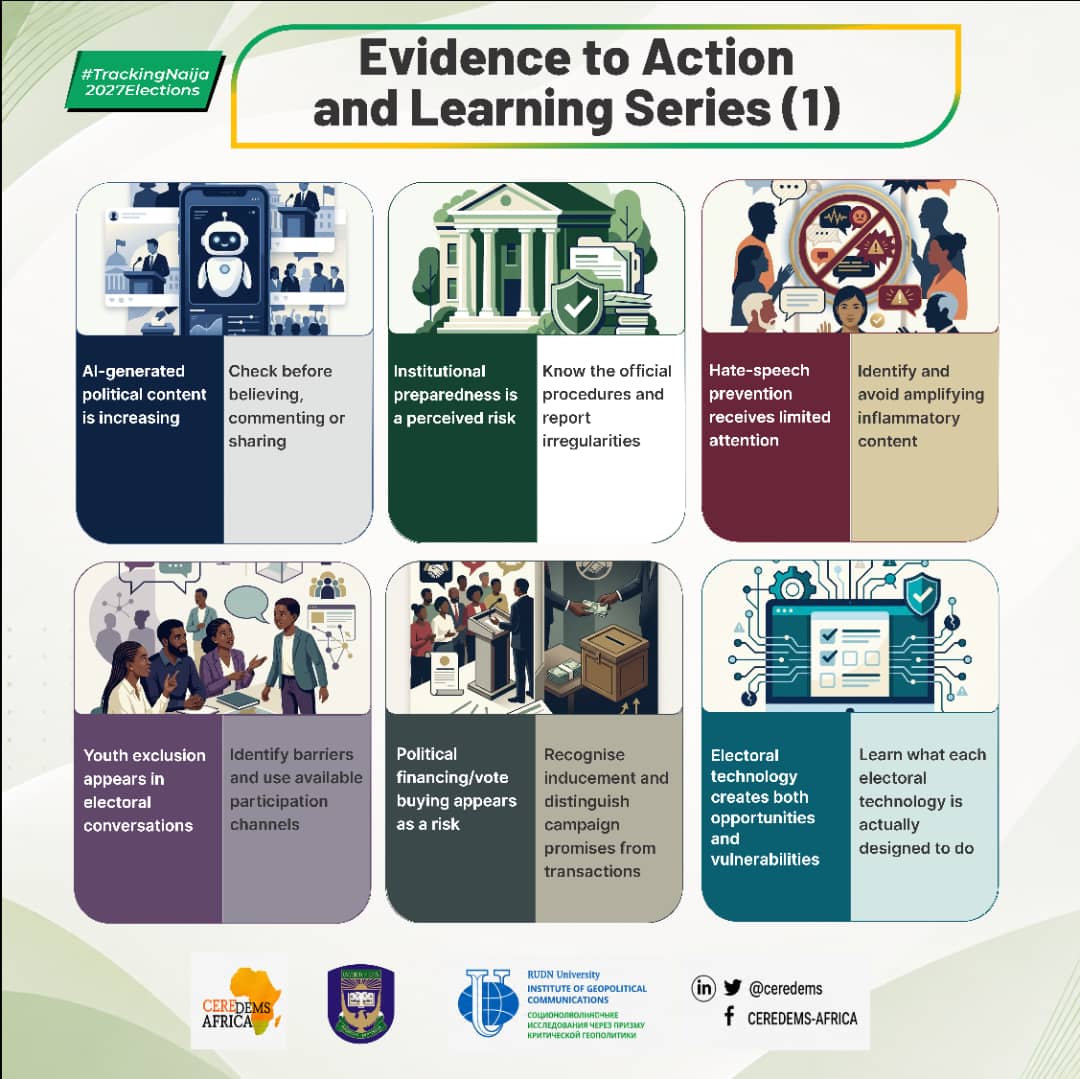
As Nigeria prepares for the 2027 general elections, the Centre for Research on Ethnic Discrimination and Electoral Management Studies (CEREDEMS-Africa) has identified six issues emerging from its monitoring of campaign activities and electoral discourse since August 2026.
The findings are contained in the first edition of its “Evidence to Action and Learning Series”, produced under the #TrackingNaija2027Elections project in collaboration with the RUDN University Institute of Geopolitical Communications.
AI and political content

The increasing use of generative artificial intelligence in political communication is one of the trends identified by the monitoring.
CEREDEMS advises voters to verify the source and authenticity of political content before sharing it, particularly when material appears designed to provoke strong emotional reactions.
Institutional preparedness
Concerns about the preparedness of electoral institutions also feature in public discourse tracked by the project.
Voters are encouraged to rely on official electoral procedures and channels when seeking information or reporting irregularities, rather than acting on unverified claims.
Hate speech
The monitoring identifies limited attention to hate-speech prevention despite its potential implications for electoral participation.
Citizens can help reduce its spread by refusing to amplify inflammatory ethnic, religious or political content.
Youth participation
Youth exclusion remains another issue in the electoral conversation.
The learning series encourages young Nigerians to engage through voter education, town halls, civic dialogues and other lawful forms of participation.
Vote buying
Political financing and vote buying have also emerged as electoral concerns.
CEREDEMS urges voters to distinguish between campaign promises and inducements, particularly where money, gifts or favours are offered in connection with voting decisions.
Electoral technology
The final area is electoral technology, which can support transparency while also generating confusion when poorly understood.
Voters are encouraged to obtain information about BVAS, IReV and other electoral technologies from official sources and not rely on rumours circulating online.
CEREDEMS-Africa said the learning series is designed to turn evidence gathered through its monitoring into practical civic lessons ahead of the 2027 elections.
“Evidence is only useful when it leads to action,” CEREDEMS-Africa analysts said.
The organisation said further evidence-to-action briefs will be released as the #TrackingNaija2027Elections project continues to monitor campaign activities, information integrity, hate speech, artificial intelligence, youth inclusion and other electoral issues.
GATMASH NEWS
…News That Drives Impact
For advert placements and business inquiries, kindly reach us via:
📧 Email: [email protected]
📞 Tel/WhatsApp: +234 (0) 807 202 2024
We value your voice! Share your stories, eyewitness reports, and contributions with us anytime:
📲 SMS/WhatsApp: +234 (0) 807 202 2024
📧 Email: [email protected]
Visit us online: https://gatmash.com