
By Theresa Moses
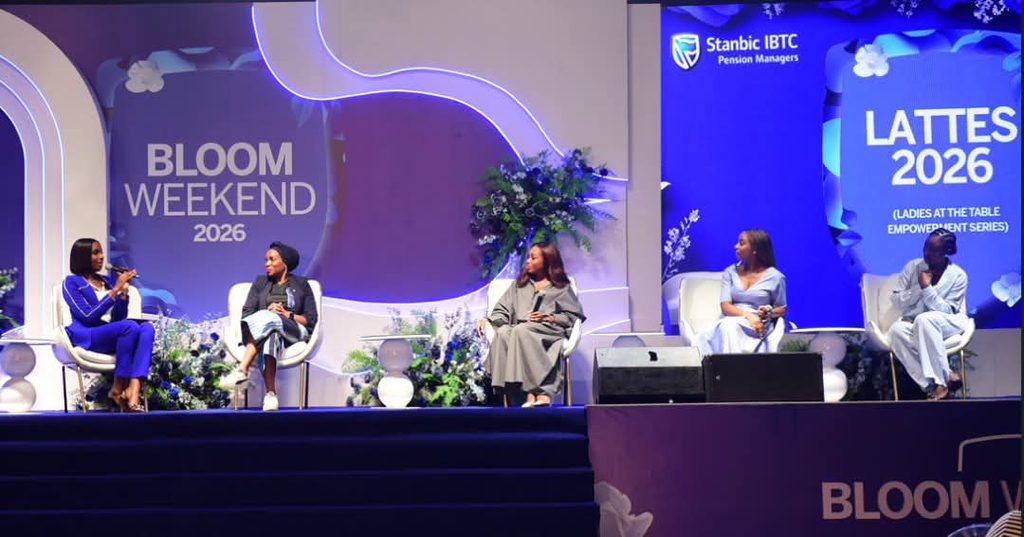
- Bank highlights affordable financing, mentorship, business networks and pension planning as key drivers of women’s economic empowerment at Bloom Weekend 2026.
Stanbic IBTC has reiterated its commitment to advancing women’s economic empowerment through access to finance, business development support, mentorship, professional networks and long-term financial planning, as it prepares for the 2026 edition of Bloom Weekend.
At a media parley held in Lagos on Friday, November 13, 2026, executives of Stanbic IBTC outlined the financial solutions and support structures the organisation says it is providing to help women entrepreneurs strengthen their businesses, overcome growth barriers and transition from business ownership to sustainable enterprise leadership.
The discussion featured Olajumoke Bello, Head, Enterprise, Stanbic IBTC Bank; Nike Bajomo, Executive Director, Stanbic IBTC Pension Managers; and Tosin Leye-Odeyemi, Head, Personal Banking, Stanbic IBTC Bank.
This year’s Bloom Weekend theme, “Bloom Into Growth: From Business Owner to CEO,” captures the transition from simply running a business to building a structured, scalable and sustainable enterprise.
For women building businesses in Nigeria, that transition involves more than increasing sales or expanding operations. It requires leadership capacity, sound business structures, access to appropriate financing, professional networks and the ability to build enterprises that can grow beyond their founders’ daily involvement.
Speaking on the bank’s enterprise support strategy, Bello explained that women entrepreneurs require more than encouragement to grow. They need access to appropriate financing, business knowledge and support systems that can help them manage expansion and build sustainable operations.
She highlighted the Blue Blossom proposition, Stanbic IBTC’s offering designed to support women in business through financial solutions and business development opportunities.
The proposition includes working capital facilities to support daily business operations, asset financing for the acquisition of equipment and other business essentials, as well as longer-term loan facilities for businesses with expansion plans.
Bello also discussed the availability of concessionary lending rates for eligible women-owned businesses, subject to the bank’s assessment and lending requirements.
Her presentation addressed a major concern among women entrepreneurs: the difficulty of securing affordable financing to move their businesses from small-scale operations to more structured and competitive enterprises.
The discussion reinforced the importance of financial solutions that respond to different stages of business development, rather than a one-size-fits-all approach.
While access to capital remains important, Leye-Odeyemi emphasised that financing alone cannot address all the challenges women face in business and professional life.
Responding to a question on why the bank created Bloom Weekend when it already offers financial products and services, she explained that women also need mentorship, guidance, networks and opportunities to learn from others who have navigated similar journeys.
She said the platform connects women to the Blue Blossom community, creating opportunities to interact with experienced professionals and entrepreneurs, exchange ideas, share experiences and build relationships that can support their growth.
She highlighted the importance of hearing from women who have faced challenges and made progress, while providing participants with a community where they can encourage and support one another.
Her contribution underscored the role of peer learning and professional relationships in helping women make informed decisions, build confidence and navigate the demands of business growth.
The message was clear: sustainable empowerment requires more than access to financial products; it also requires an environment where women can learn, connect and grow together.
Bajomo brought another important dimension to the conversation by focusing on retirement planning and the need to make pension participation accessible to women outside formal employment.
She explained that the Personal Pension Plan provides an opportunity for self-employed individuals and people working in the informal sector to make voluntary contributions towards retirement.
This is particularly relevant to women who run small businesses, trade, provide professional services or work independently without the pension arrangements commonly associated with formal employment.
Unlike conventional workplace pension arrangements, the plan allows participants to make contributions according to their financial capacity. During the discussion, Bajomo illustrated this flexibility with examples of small daily contributions, including amounts such as ₦500 and ₦800.
Her explanation highlighted how women who may not have access to formal retirement benefits can begin building financial security through regular savings, even when their earnings fluctuate.
She also challenged the assumption that children should be regarded as their parents’ retirement plan, urging women to take responsibility for their financial future through independent planning.
The discussion placed retirement security alongside entrepreneurship as an important part of women’s economic empowerment, particularly for those who spend years building businesses without formal employment benefits.
Bajomo also spoke about the Ladies at the Table Empowerment Series (LATTES), an initiative she said began six years ago to create opportunities for conversations around women’s advancement.
The platform addresses issues including leadership, career development, financial wellbeing, health and wellness, and the experiences of women navigating professional and personal responsibilities.
Through these conversations, the initiative seeks to provide women with practical knowledge, relevant perspectives and opportunities to learn from others.
The inclusion of LATTES in the discussion demonstrated that Stanbic IBTC’s engagement with women’s empowerment extends beyond a single annual event to other platforms focused on women’s development.
An important issue raised during the media parley was how the bank evaluates the long-term impact of its women’s empowerment initiatives.
The response acknowledged that a clearly defined methodology for measuring all the long-term outcomes was not yet in place. Feedback and testimonials were mentioned as part of the ways the organisation assesses participants’ experiences, alongside indicators relating to the uptake of its financial products.
The question raises a wider issue for corporate empowerment programmes: how success is measured beyond attendance, participation and positive feedback.
For women entrepreneurs, the real test is whether these interventions translate into improved access to affordable finance, stronger business operations, increased revenue, job creation and sustainable growth.
For women in the informal sector, increased pension participation and better retirement preparedness are equally important indicators.
Similarly, mentorship and networking initiatives should be assessed by the opportunities, business relationships and practical support they generate for participants after the event.
Bloom Weekend 2026 brings together several important elements of women’s economic advancement: access to finance, business development, mentorship, professional networking and long-term financial planning.
GATMASH NEWS
…News That Drives Impact
For advert placements and business inquiries, kindly reach us via:
📧 Email: [email protected]
📞 Tel/WhatsApp: +234 (0) 807 202 2024
We value your voice! Share your stories, eyewitness reports, and contributions with us anytime:
📲 SMS/WhatsApp: +234 (0) 807 202 2024
📧 Email: [email protected]
Visit us online: https://gatmash.com