

Journalists have been challenged to leverage their influence in shaping public opinion to combat stigma associated with substance use disorders and promote evidence-based approaches to addiction prevention across Nigeria.
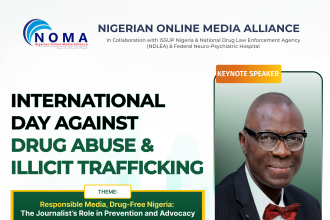
The call was made by Dr. Olajumoke Koyejo, a public health and addiction prevention expert, and International Society of Substance Use Prevention and Treatment Professionals (ISSUP) Nigeria President during a presentation titled “Breaking the Stigma: Public Health and Digital Approaches to Substance Use Prevention in Nigeria” at the Media Practitioners’ Capacity Building Programme organized by the Nigerian Online Media Alliance (NOMA), a coalition of digital media publishers and journalists committed to promoting ethical journalism, media development, and impactful public advocacy across Nigeria, in collaboration with the International Society of Substance Use Prevention and Treatment Professionals (ISSUP Nigeria), the National Drug Law Enforcement Agency (NDLEA), and the Federal Neuro-Psychiatric Hospital, Yaba on Thursday.
Speaking in commemoration of the 2026 International Day Against Drug Abuse and Illicit Trafficking, Dr. Koyejo emphasized that addiction should be viewed as a chronic health condition rather than a moral failing, stressing that societal misconceptions continue to hinder prevention and treatment efforts.
According to her, addiction is a long-lasting and relapsing brain disease that affects mood, thinking, behaviour, perception and consciousness, resulting from the use of psychoactive substances or compulsive behaviours that become central to an individual’s life.

She explained that addiction can manifest in both substance-related forms, including cannabis, alcohol, cocaine, opioids and amphetamines, as well as behavioural addictions such as gambling and excessive screen use.
“Society has traditionally viewed addiction as a moral weakness or personal failure, but scientific evidence clearly shows that addiction is a health condition influenced by biological, psychological and social factors,” she said.
Dr. Koyejo noted that stigma remains one of the greatest barriers to addressing substance use disorders in Nigeria, often preventing affected individuals from seeking help while encouraging families and communities to conceal the problem.
“When people are labelled, stereotyped or discriminated against because of addiction, they are less likely to access treatment. Communities deny the existence of the problem, and policymakers may underinvest in prevention and treatment services,” she explained.
Highlighting the scale of the challenge, the expert cited data from the United Nations Office on Drugs and Crime (UNODC), indicating that approximately 14.4 per cent of Nigerians between the ages of 15 and 65 use psychoactive substances. Cannabis, opioids, tramadol, codeine-containing cough syrups, alcohol, tobacco and synthetic substances are among the most commonly used substances.
She further disclosed that studies have shown gambling prevalence rates of up to 40 per cent among the same age group, underscoring the growing concern over behavioural addictions.
Dr. Koyejo warned that young people remain particularly vulnerable to the devastating effects of addiction due to the developmental changes occurring during adolescence.

“Addiction hijacks normal brain functioning. Early exposure to substances significantly increases the risk of long-term addiction and mental health challenges. That is why prevention remains more effective and less costly than treatment,” she said.
Advocating for a public health approach, she urged stakeholders to move beyond blame and punishment and focus on evidence-based prevention strategies.
She identified family engagement, school-based education, community participation and supportive government policies as critical pillars of effective prevention.
According to her, parents who communicate effectively with their children, provide emotional support and monitor adolescent activities significantly reduce the likelihood of substance use among young people.
She also stressed the importance of equipping schools with life skills education, mental health literacy programmes and factual drug education rather than fear-based campaigns.
Beyond traditional prevention strategies, Dr. Koyejo highlighted the growing role of digital technology and artificial intelligence in addressing addiction and substance use disorders.
She noted that Nigeria’s large population of internet and smartphone users presents unprecedented opportunities for expanding prevention efforts and connecting vulnerable individuals to support services.
“Digital technologies can reach large populations quickly, provide anonymous support, deliver health education at low cost and connect individuals with professional services,” she said.
The public health expert noted that artificial intelligence-powered tools are increasingly being used to identify risk patterns, conduct screening assessments, provide personalized health information and facilitate referrals to treatment.
She particularly highlighted the ISSUP Nigeria VibeCheck platform, a digital screening, brief intervention and referral tool designed to help individuals assess their risk levels and seek appropriate support before substance use problems escalate.
Turning her attention to the media, Dr. Koyejo described journalists as critical partners in public health advocacy and addiction prevention.
She urged media practitioners to adopt person-first language, avoid sensational reporting, promote factual information and highlight recovery stories that inspire hope rather than reinforce stereotypes.

“Journalists do more than report events. They shape public understanding, influence policy discussions and determine how society views people living with addiction. The media can either reinforce stigma or promote recovery and compassion,” she stated.
She encouraged journalists to consult addiction specialists, researchers and public health professionals when reporting on substance use issues and to focus on solutions-driven reporting that highlights effective interventions.
In her concluding remarks, Dr. Koyejo reiterated that all forms of addiction are health conditions rather than moral failures and called for a united effort to ensure that prevention programmes are evidence-based, community-driven and technologically enabled.
“The media has the power to transform public understanding. By reporting responsibly, challenging stigma and promoting evidence-based information, journalists can become key allies in preventing addiction and supporting recovery,” she said.

She expressed optimism that through collaboration among healthcare professionals, policymakers, technology innovators and the media, Nigeria can build a future where individuals seek help without fear, prevention reaches every community, and recovery is embraced with dignity and support.
GATMASH NEWS
…News That Drives Impact
For advert placements and business inquiries, kindly reach us via:
📧 Email: [email protected]
📞 Tel/WhatsApp: +234 (0) 807 202 2024
We value your voice! Share your stories, eyewitness reports, and contributions with us anytime:
📲 SMS/WhatsApp: +234 (0) 807 202 2024
📧 Email: [email protected]
Visit us online: https://gatmash.com