
By Theresa Moses
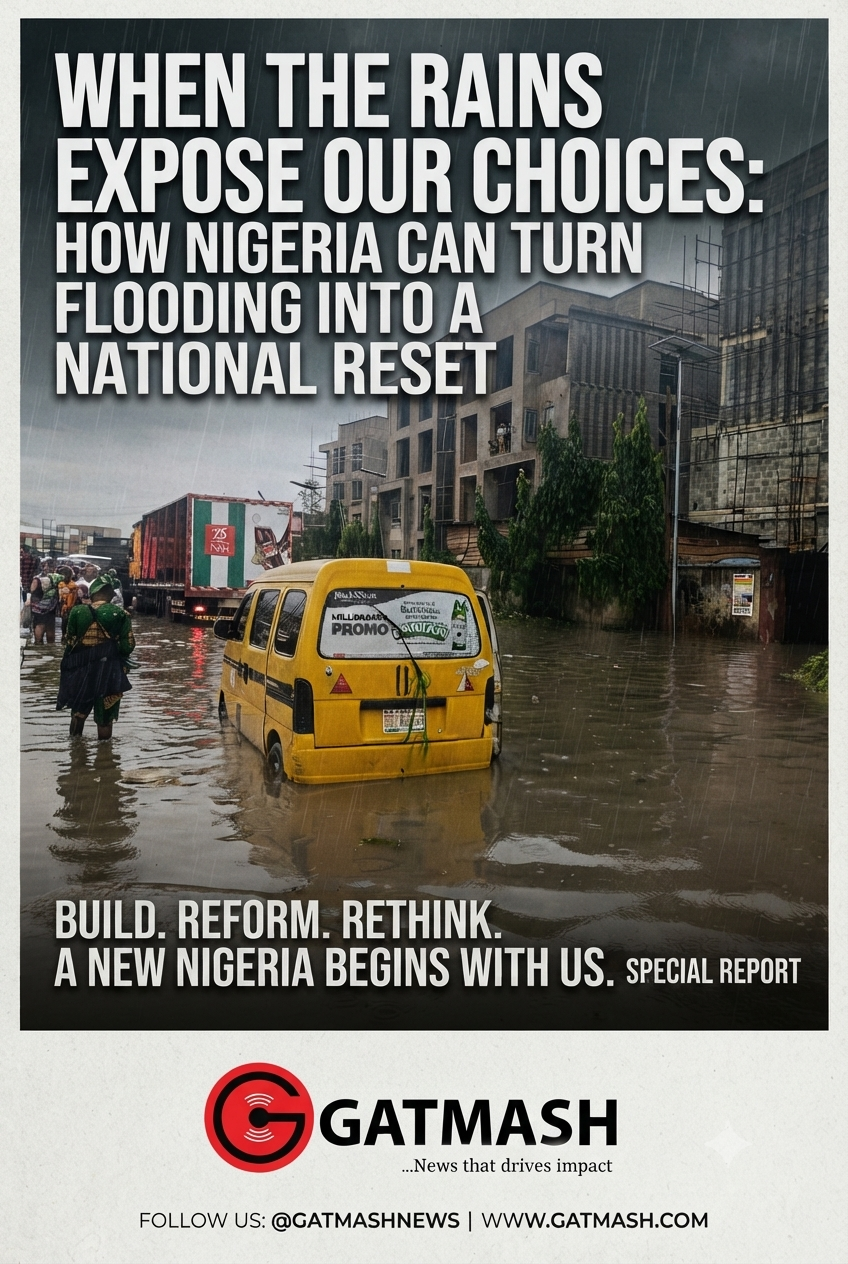
Every rainy season, the same heartbreaking images return. Children wading through dirty floodwaters to get to school. Families watching years of hard work disappear beneath muddy water. Motorists stranded on submerged roads. Businesses shut down. Communities cut off. Electricity knocked out. Government officials issue warnings. Citizens vent their frustrations on social media.
Then, when the water recedes, so does the urgency. Until the next rainfall.
Last week’s devastating floods across Lagos: from FESTAC, Gbagada and Ikeja to Ajah, Lagos Island and beyond; were not merely the result of hours of heavy rain. They were a painful reminder that flooding in Nigeria has become a governance challenge, an environmental challenge, a planning challenge and, ultimately, a civic challenge.

It is tempting to blame climate change alone. Indeed, changing weather patterns are making rainfall more intense across West Africa. But climate change does not block drainage channels with plastic waste. It does not approve buildings on natural waterways. It does not convert wetlands into housing estates without adequate environmental assessments.
People do. And institutions allow it.
The Disaster We Keep Building
For decades, Nigerians proudly said our country was spared many natural disasters.
- No earthquakes.
- No hurricanes.
- No volcanic eruptions.
Perhaps that comfort made us believe that disaster preparedness was someone else’s concern.
History teaches a different lesson.
- Japan became a global leader in earthquake engineering because earthquakes demanded innovation.
- The Netherlands mastered water management because survival depended on it.
- Singapore transformed urban drainage through long-term planning and strict enforcement.
These countries did not become resilient because they were lucky.
They became resilient because they treated every disaster as a lesson rather than a recurring headline.
Nigeria now has the same opportunity.
The question is whether we are willing to learn.
Policies Are Not the Problem
Nigeria already has
- Flood management policies.
- There is the National Emergency Management Agency (NEMA).
- There are annual flood outlook reports.
- Environmental regulations exist.
- Urban planning laws exist.
- Drainage master plans exist.
The problem has never been the absence of documents. The problem is implementation.
Too often, illegal structures remain standing despite repeated warnings.
- Drainage channels become refuse dumps.
- Developers reclaim wetlands with little consequence.
- Construction approvals ignore environmental realities.
- Maintenance only begins after lives and livelihoods have already been disrupted.
A policy that is never enforced is little more than paper.
Flooding Is No Longer Just an Environmental Issue
Every flood creates multiple crises simultaneously.
- Children miss school.
- Hospitals become inaccessible.
- Businesses lose revenue.
- Electricity infrastructure is damaged.
- Road networks collapse.
- Food prices increase because transportation is disrupted.
- Waterborne diseases spread.
- Insurance claims rise.
- Investors lose confidence.
What appears to be an environmental problem quickly becomes an economic problem, a health problem and a national productivity problem.
The cost of rebuilding after every flood is significantly higher than the cost of preventing one.
The Role of Every Nigerian
The government must lead. But citizens must participate. It is impossible to build resilient cities while residents continue dumping refuse into drainage channels.
It is impossible to reduce flooding when canals are converted into residential plots.
It is impossible to demand accountability while ignoring environmental laws ourselves.
Flood resilience begins with everyday choices.
Every plastic bottle thrown into a drain contributes to someone’s flooded home.
Every illegal building erected on a waterway redirects floodwater into another community.
Every ignored environmental warning eventually becomes tomorrow’s emergency.
A Different Conversation
Rather than asking why flooding happens every year, perhaps we should ask different questions.
Why are drainage systems not maintained before the rains begin?
Why are flood-risk maps not guiding urban development?
Why are communities not trained in local flood preparedness?
Why do emergency responses remain reactive rather than preventive?
Why do we rebuild damaged infrastructure only to repeat the same mistakes?
These questions move us away from blame and toward solutions.
What Needs to Change
Nigeria’s flood strategy should move beyond emergency response to long-term resilience.
Governments at all levels must invest in modern drainage infrastructure, restore blocked waterways, protect wetlands, enforce planning regulations without compromise, and embrace technology for flood forecasting and real-time monitoring.
Local governments should establish community drainage maintenance programmes involving residents.
Schools should incorporate environmental responsibility into civic education.
Private organisations should support climate adaptation projects as part of corporate social responsibility.
Media organisations must continue informing, educating and holding institutions accountable.
Most importantly, environmental laws should apply equally to everyone, regardless of influence or status.
A National Reset
Floodwater does not recognise social class.
It enters luxury estates and low-income communities alike.
It disrupts the lives of both business executives and street traders.
Eventually, everyone pays.
The water that spares one neighbourhood today may overwhelm another tomorrow.
Flooding should no longer be treated as an unavoidable seasonal inconvenience.
It should become the catalyst for building smarter cities, stronger institutions and more responsible communities.
The real tragedy is not that Lagos flooded.
The real tragedy would be learning nothing from it.
Every rainfall is testing our preparedness.
Every flood is exposing our choices.
The question before Nigeria is no longer whether the rains will come. They will.
The real question is whether we will continue rebuilding after every disaster or finally build a country that is prepared before the next storm arrives.
- Theresa Moses writes on governance, public policy, sustainable development and social impact. She is the Publisher of GATMASH NEWS
GATMASH NEWS
…News That Drives Impact
For advert placements and business inquiries, kindly reach us via:
📧 Email: [email protected]
📞 Tel/WhatsApp: +234 (0) 807 202 2024
We value your voice! Share your stories, eyewitness reports, and contributions with us anytime:
📲 SMS/WhatsApp: +234 (0) 807 202 2024
📧 Email: [email protected]
Visit us online: https://gatmash.com