
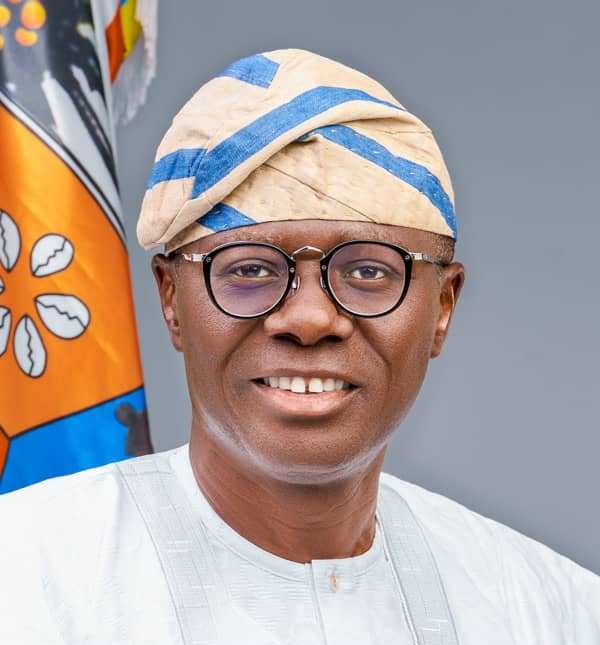
For Governor Babajide Sanwo-Olu of Lagos State, his legacy is already screaming, writes Adefemi Abdul-Lateef
The 2026 Reform and Diplomatic Roundtable, held last week, was a special day in the annals of the Lagos State body politic.
It was an event organised by the Presidential Enabling Business Environment Council in collaboration with UK International Development and Nigeria Economic Stability and Transformation Programme.
At the gathering, Lagos was ranked the best state for doing business in Nigeria, according to a new report assessing subnational business environments.

The ranking reflects the state’s strong infrastructure, efficient regulatory systems, and robust market access, and reinforcing its position as the country’s leading commercial hub.
Lagos was named top-performing state in Nigeria with a score of 85.6% ahead of Kaduna, Oyo, FCT, Ogun, Enugu, Plateau, Ekiti, Kano, and Nasarawa.
Shedding more lights on the criteria for the ranking during a chat with Arise TV Global Business Report, the Director-General of PEBEC, Zahrah Audu, said the report indicated that sustained reforms across states are beginning to yield positive results.
He noted that it is getting easier doing business in Nigeria, though it is still a work in progress, and the country is nowhere near perfect, but she was confident Nigeria is beginning to hold itself more accountable.
Highlighting why Lagos came top, Audu said: “One of the key reasons why Lagos ranked top is simply the digitalisation and automation of majority of their services –everything – from land registration, now which you can do end-to-end without needing a physical signature from the executive governor, to the tax system, which has been automated and digitalised.
“The levies have sort of been reduced and streamlined so that it’s easier to go online and pay your state levies through a one-stop shop which they have, their grievance address mechanism which seems to be one of the better ones when you talk about state grievance address mechanisms.
“So, there are the things they have put in place. Also, not to forget that they are probably the only state that has a functional commercial court at the moment, which is very important when you talk about business because people who invest need to know that if they have issues there is a robust legal system. They also have a fantastic ADR system. So, these are some of the factors that have led to that ranking.”
The 2025 PEBEC report indicated that Lagos-led reforms have improved the business environment for both local and international investors and strengthened its position as a major economic powerhouse in Africa.
Audu, therefore, emphasised that the PEBEC agenda is not to name and shame any state, but instead to ensure that other states could take a cue from those performing brilliantly under the various indicators.
“What we are trying to do is showcase other states, what they need to do to also improve the business climate within their states. This is why we continue to emphasise the top ten,” she said, adding: “The main end goal is to fix the system.”
The sixteen listed key indicators used to evaluate the state were; access to electricity, infrastructure, digital connectivity, land registration, small claim courts, investor aftercare, workforce development, crisis resilience, dispute resolution, market access, getting credit, export-import facilitation, interstate trade, paying taxes, grievance redress mechanism, and access to skilled labour.
According to Audu, “We try as much as possible to cover several unique factors of doing business in Nigeria, hence the multiple indicators. Every specific indicator is to help us understand the clarity of the Nigerian business sector.
“We worked very closely with several consultants. We had a lot of help from the World Bank and the European Union (EU), guiding and helping us to navigate. And of course, we took into consideration, the local factors within Nigeria.”
Addressing the roundtable, which attracted policy makers, private sector participants, development partners, the academia and civil society, Governor Sanwo-Olu attributed the state’s dramatic rise in the ranking from 29th place four years ago to first place to “deliberate efforts” by his administration to implement consistent reforms, infrastructure upgrades, and policies designed to enhance business competitiveness.
“This is the result of deliberate efforts by our government to create a positive environment for local and foreign investments, not just to thrive but to ensure good returns. We will continue to push for more investments and make our state a truly business-friendly place,” he stated.
Reiterating that the ranking reflects the success of efforts to reduce bureaucratic bottlenecks in land administration, construction permits, and digital service delivery, the governor assured Nigerians that he would continue to strengthen Lagos economic landscape, with the aim to make it the most attractive market for enterprise and innovation in Nigeria.
Noting that the ranking is as a result of sustained institutional reforms and policy consistency, Lagos State Commissioner for Commerce, Cooperatives, Trade and Investment, Folashade Bada, said the achievement was not by chance.
“Our position is not accidental. It is the outcome of sustained institutional reforms, policy discipline, and a clear recognition that capital flows where there is clarity, confidence, and continuity,” she said, stressing further that the state’s progress is anchored on the Lagos State Development Plan 2052, designed to ensure long-term economic transformation.
Apart from reforms in land administration, construction permits and taxation, have improved transparency and reduced delays for businesses, with low-risk construction permits now processed within 15 working days,
Lagos has also invested in infrastructure such as fibre-optic networks, transport systems, and logistics, and other activities aimed at attracting investors.
With PEBEC’s agenda to create a more transparent and competitive business climate, the Minister of Budget and Economic Planning, Abubakar Bagudu, was optimistic that Nigeria’s ambition to build a $1 trillion economy could be achieved through the roles played by states and the private sector.
“We feel confident that with that mindset, led by the private sector, we can create a $1 trillion economy, supported by the response that our economy has experienced doing what is right,” he said.
However, as Nigeria looks towards the subnationals to propel its economy, Lagos is getting good results on investment as it continues to attract both local and foreign investments.
Not only did Nigerian billionaire businessman, Alhaji Aliko Dangote situate his multibillion dollar investments in the state, including the $20 billion Dangote Refinery, in 2018, he described Lagos as the most peaceful place to do business in Nigeria, encouraging local business communities and residents to pay their taxes to the state to support further infrastructure development.
Dangote announced plans to move the headquarters of his industrial empire to Eko Atlantic City in Lagos, reinforcing his confidence in the state’s economy future.
Although Lagos has had some outstanding governors since the advent of the fourth republic, without prejudice to any of his predecessors, the outgoing governor, Mr. Babajide Sanwo-Olu, has exemplified himself by his unique characters and some remarkable legacies he would be leaving behind.
While one must reckon with the simplicity Sanwo-Olu has brought into governance, his ability to mingle with people from all social strata without allowing his office to influence his attitude to Lagosians of all cadres speaks more.
While he has refused to drop the ball in spite of the pressure of his final leg in office and also not giving in to the second term syndrome, Governor Sanwo-Olu has by the dint of hard work achieved an enduring Legacy, the type that will scream louder only after he leaves office.
Abdul-Lateef lives and works in Ikeja GRA
GATMASH NEWS
…News That Drives Impact
For advert placements and business inquiries, kindly reach us via:
📧 Email: [email protected]
📞 Tel/WhatsApp: +234 (0) 807 202 2024
We value your voice! Share your stories, eyewitness reports, and contributions with us anytime:
📲 SMS/WhatsApp: +234 (0) 807 202 2024
📧 Email: [email protected]
Visit us online: https://gatmash.com/