

By: Theresa Moses
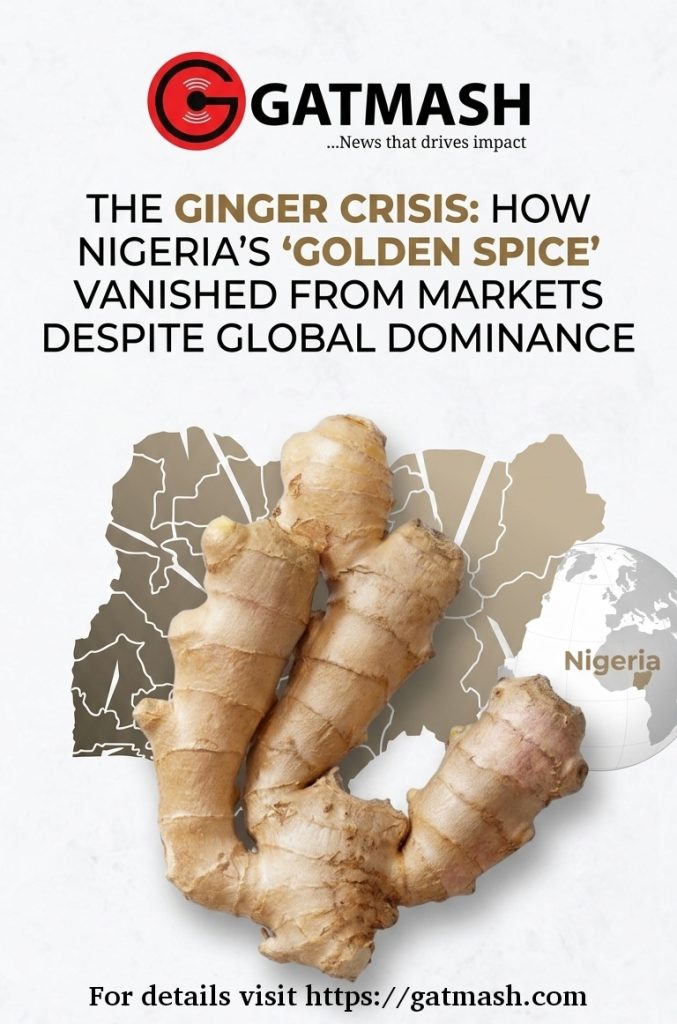
Despite Nigeria ranking among the world’s top ginger producers, the spice has become increasingly scarce and expensive; leaving farmers, traders, and consumers struggling under the weight of production decline, pest attacks, and market forces.
Ginger (Zingiber officinale), one of Nigeria’s most valuable agricultural exports and widely used medicinal spices, has long been a major source of income for farmers across the northern region; particularly in Kaduna State, which accounts for over 70 percent of national output.
Nigeria is ranked as the second-largest ginger producer in the world, with annual production estimated between 500,000 and over 800,000 metric tonnes. However, despite this strong position, the country’s ginger sector is currently facing one of its most severe production crises in recent years.

A CRASH THAT DEFIED FOOD PRICE TRENDS
While Nigeria has recently witnessed a decline in the prices of several staple food crops, ginger has moved in the opposite direction.
Market reports across northern trading hubs show that a bag of dried ginger, which previously sold for about ₦180,000, now goes for between ₦600,000 and ₦610,000. Similarly, a small measure (mudu), once sold at about ₦2,700, now costs as high as ₦28,000, depending on quality and purity.
Traders say the commodity has remained stubbornly expensive, with no significant price relief in sight.
THE BLIGHT THAT SHOOK THE INDUSTRY
Industry stakeholders attribute the crisis largely to a combination of pest attacks, crop disease, and production disruptions that began around 2023.
According to agricultural data and farmer testimonies, large-scale infestations in major producing areas; especially in southern Kaduna, destroyed thousands of hectares of farmland, estimated at over ₦12 billion in losses.
Farmers say the impact was devastating. Many who once harvested hundreds of bags of ginger reported massive output drops, with some recording losses of over 90 percent due to crop failure.
One farmer, Emmanuel Gabriel from Kachia Local Government Area, described how his harvest dropped from about 600 bags to just 20 bags following repeated attacks.
A STRUGGLING FARMING ECONOMY
Ginger farming communities across Kaduna, Nasarawa, Niger, Gombe, Bauchi, and the Federal Capital Territory continue to struggle with reduced yields and rising production costs.
Despite Nigeria’s global reputation in the spice trade, the domestic supply chain has weakened significantly, affecting both local consumption and export capacity.
Experts say the decline has been worsened by reduced productivity, limited access to improved seedlings, and lingering effects of crop diseases that have not yet been fully contained.
EXPORT PRESSURE AND GLOBAL DEMAND
Beyond production challenges, rising global demand has also played a major role in shaping Nigeria’s domestic scarcity.
Nigerian ginger remains highly sought after in international markets including India, China, the Netherlands, Saudi Arabia, the United Arab Emirates, and the United States.
Exporters say increased foreign demand has pulled more supply out of local markets, contributing further to domestic shortages and price hikes.
Alhaji Hamisu Inuwa, a spice trader, explained that the global appeal of Nigerian ginger has made it increasingly difficult for local consumers to access affordable quantities.
FARMERS CAUGHT BETWEEN LOSS AND RECOVERY
For many farmers, the ginger industry has shifted from a profitable venture to a survival struggle.
Alhaji Isah Garba, a long-time farmer and trader in the Yankaba spice market, noted that the sector has not recovered from the shocks of pest infestations and declining yields.
He explained that both production challenges and rising export demand have combined to push prices upward, making ginger increasingly unaffordable for ordinary households.
POLICY INTERVENTIONS AND GOVERNMENT RESPONSE
In response to the crisis, the Federal Government established the Ginger Blight Epidemic Control Task Force, aimed at addressing the outbreak and restoring productivity in affected regions.
The National Agricultural Development Fund (NADF) also introduced a ₦1.6 billion intervention programme, targeting affected farmers across Kaduna, Plateau, Nasarawa, and the FCT under the Ginger Recovery Advancement and Transformation for Economic Empowerment (GRATE) initiative.
Officials say the programme is designed to provide inputs, improve yields, and restore lost productivity, although stakeholders argue that recovery remains slow and uneven.
A COMPLEX DEBATE: SEEDS, SYSTEMS AND STRUCTURES
Beyond environmental and policy factors, broader debates have emerged around the structure of Nigeria’s ginger production system.
Some agricultural commentators and online discussions have raised controversial claims regarding seed systems, international partnerships, and farming inputs introduced under past agricultural intervention programmes. However, these claims remain widely debated and are not officially substantiated by government or international agricultural bodies.
Experts emphasize that the core challenges in the sector remain rooted in disease outbreaks, weak supply chains, limited mechanization, and insufficient investment in agricultural resilience systems.
THE HUMAN IMPACT
At the heart of the crisis are thousands of farmers whose livelihoods depend on ginger cultivation.
Across Kaduna’s rural communities, many producers say they are still recovering from losses incurred over the past few years. Some have reduced cultivation entirely, while others have shifted to alternative crops due to uncertainty in the ginger market.
CONCLUSION: CAN NIGERIA RECLAIM ITS GINGER LEADERSHIP?
Nigeria’s position as a global ginger powerhouse remains intact on paper, but the realities on the ground tell a different story; one of shrinking yields, rising prices, and struggling farmers.
Unless sustainable solutions are implemented; ranging from disease control to improved agricultural inputs and stronger value chains; the country risks losing further ground in a sector where it once held significant global influence.
For now, ginger remains both a symbol of Nigeria’s agricultural potential and a warning sign of its unresolved structural challenges.
GATMASH NEWS
…News That Drives Impact
For advert placements and business inquiries, kindly reach us via:
📧 Email: [email protected]
📞 Tel/WhatsApp: +234 (0) 807 202 2024
We value your voice! Share your stories, eyewitness reports, and contributions with us anytime:
📲 SMS/WhatsApp: +234 (0) 807 202 2024
📧 Email: [email protected]
Visit us online: https://gatmash.com