
From costly phone calls to a digital economy, Globacom’s 23-year journey is also the story of how connectivity transformed the way Nigerians communicate, work and do business.
By Theresa Moses
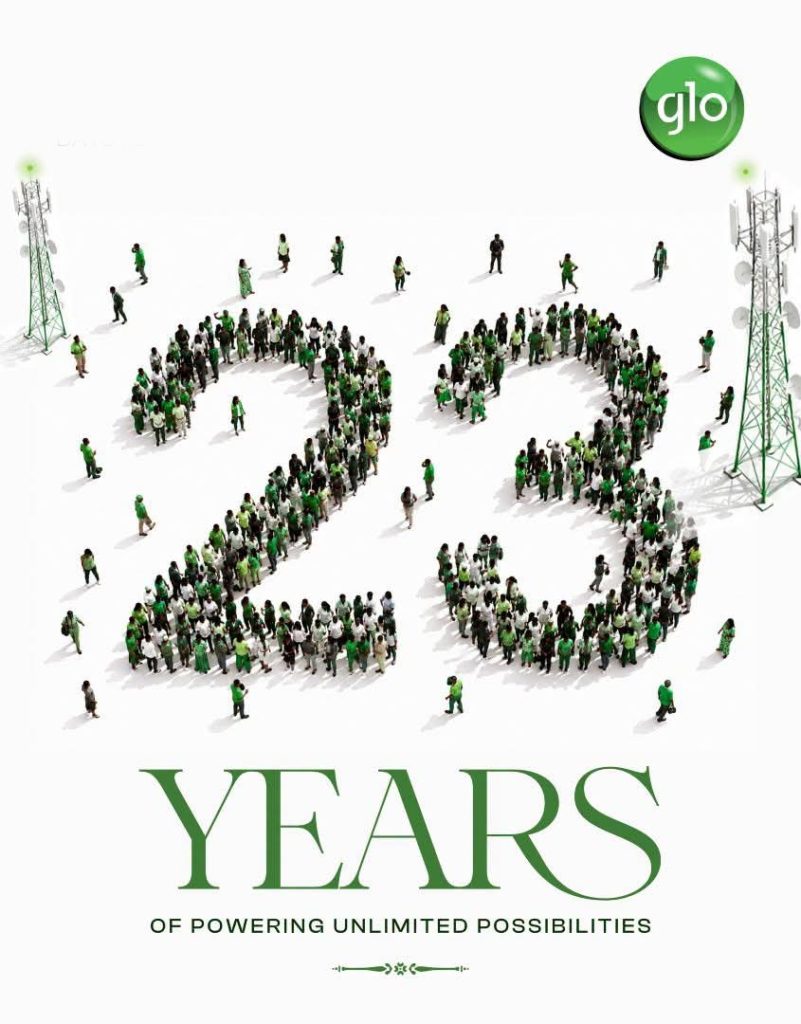
In 2003, owning a mobile phone in Nigeria was still a privilege. You watched the clock before making a call. You calculated the cost. Sometimes, rather than call, you simply gave a missed call and waited for the other person to call back. For many Nigerians, the challenge was not only the cost of making calls. Access itself was expensive.
Then Globacom entered the market. Twenty-three years later, it is difficult to imagine Nigeria without the telecommunications revolution that followed. The phone that was once primarily a device for making calls has become a bank, classroom, office, marketplace, entertainment centres and business tool. But Glo’s contribution to that transformation was not simply about putting another network in the market. Its significance lies in how it helped make telecommunications more accessible to ordinary Nigerians.
When Owning a Phone Was Expensive
When GSM services were introduced, telecommunications was expected to liberalise the industry and expand access. Yet, according to accounts from the period, getting a line remained expensive. A SIM line that could cost around ₦600,000 in the earlier era was still being sold for tens of thousands of naira after other operators entered the market. The arrival of Glo brought another dramatic shift, with the cost reportedly coming down to about ₦6,000, then ₦2,000 and eventually around ₦200.
That reduction changed who could participate. The mobile phone stopped being something associated mainly with executives, professionals and the wealthy. The shoemaker could have a line. So could the mechanic, driver, trader and bus conductor. That was an important social change. Telecommunications was no longer a privilege reserved for a small segment of society. It was becoming an everyday tool for ordinary Nigerians. And affordability would become one of the defining features of Glo’s early market disruption.
The Per-Second Revolution
Glo’s introduction of per-second billing became one of the most memorable moments in Nigeria’s telecommunications history. At a time when Nigerians were largely accustomed to paying for calls by the minute, Glo challenged the model by charging customers according to the actual duration of their calls. The idea was simple, but its impact was significant. It puts the consumer at the center of the conversation. Every second mattered, and competition forced operators to rethink pricing and value. Glo had not entered an empty market. It entered a market where other operators already existed, which meant it had to give Nigerians reasons to choose its network. That competition ultimately gave consumers more choices and placed pressure on operators to improve pricing, products, network expansion and customer offerings.
From “Call Me Back” to the Digital Economy
The clearest evidence of how far Nigeria has travelled can be found in the way Nigerians communicate today. In the early days, the question was often, “How much will this call cost?”
Today, it is more likely to be, “How much data do I have left?” Voice calls have been joined by instant messaging, video calls, social media, streaming, online banking and digital commerce. The mobile phone has become a gateway to the internet; and that has fundamentally changed how Nigerians work and earn.
A trader can advertise products online and reach customers in another state without renting a shop in a major commercial center. A graphic designer in Lagos can work for a client in Abuja. A software developer can work for a company outside Africa. A student can access educational resources online. A journalist can publish from the field.
For thousands of Nigerians, connectivity has become part of their economic infrastructure.
The telecommunications revolution has also created an ecosystem of its own; airtime vendors, data sellers, phone repair technicians, installers, distributors, engineers, digital marketers, content creators and businesses whose operations depend on mobile communication. The impact therefore goes beyond the network operators. Connectivity has become woven into everyday economic activity.
The Infrastructure Nigerians Rarely See
Behind every call, message, video and online transaction is an infrastructure system that most consumers rarely think about. Globacom’s investment in that infrastructure is an important part of its 23-year story. One of its major projects is Glo-1, the submarine fibre-optic cable connecting Nigeria to the United Kingdom.
According to Globacom, the approximately 9,800-kilometre cable provides international bandwidth capacity for Nigeria and other connected markets. The company has also invested in terrestrial fibre infrastructure across Nigeria. These investments are fundamental to the digital economy. Before a Nigerian can stream a video, run an online business, attend a virtual meeting or access a digital service, information has to move through an infrastructure network.
This is why telecommunications has evolved from simply being about telephone calls into an essential platform for the wider economy.
According to Nigerian Communications Commission data cited in the original article, telecommunications contributed 9.19 per cent to Nigeria’s real GDP in the first quarter of 2026. Its importance can be seen across fintech, e-commerce, entertainment, education, healthcare and digital public services.
More Than Telecoms
Glo’s story has also been closely connected to Nigerian popular culture. Over the years, the company built a strong presence in music, football, comedy, entertainment and sports, working with prominent personalities and supporting major events. That helped position Glo as more than a telecommunications brand. It became part of the cultural environment in which its customers lived.
Behind the business is Chief Michael Adeniyi Agbolade Ishola Adenuga Jr., GCON, whose decision to enter telecommunications represented a long-term bet on Nigeria. Telecommunications is an industry where yesterday’s success cannot guarantee tomorrow’s relevance. Technology has moved from 2G to 3G, 4G and now 5G, requiring continuous investment and adaptation. That makes 23 years in such a rapidly changing industry more than a milestone. It is a story of continued participation in Nigeria’s technological evolution.
The Next Revolution Must Be About Opportunity
The telecommunications story, however, is not finished. The industry continues to face challenges around network quality, customer service, infrastructure costs, energy, taxation, regulation, vandalism and the cost of maintaining networks. The question for the next phase is therefore no longer simply whether Nigerians can connect. It is whether they can connect reliably, affordably and meaningfully. Artificial intelligence is changing the workplace. Remote work is expanding. Digital payments are becoming more important. Online education and content creation are creating new opportunities, while businesses increasingly depend on digital platforms.
For Glo and the wider telecommunications industry, the opportunity is to ensure that these opportunities do not remain concentrated in major cities or among people who can easily afford reliable connectivity. Digital exclusion can become economic exclusion. A young person without dependable internet may struggle to acquire digital skills. A small business with poor connectivity may struggle to compete. A community without adequate infrastructure may be left outside the opportunities of the digital economy. The next phase must therefore move from connecting Nigerians to empowering Nigerians.
A Legacy Still Being Written
Corporate anniversaries are often measured in numbers: years in business, subscribers, investments and infrastructure. But the human meaning of Glo’s 23 years is easier to understand through everyday experiences. It is the trader reaching a customer in another city. The farmer is speaking to a buyer. The student is learning through the phone. The entrepreneur finds a first customer online. The professional works remotely. The family stays connected across borders. Globacom did not create Nigeria’s digital economy alone. Regulators, competing operators, technology companies, infrastructure providers, entrepreneurs and millions of Nigerians who adopted and adapted the technology all contributed to the transformation.
But Glo occupies a distinctive place in that story. It entered as a Nigerian challenger, competed aggressively, twenty-three years on, the bigger story is no longer simply about making a phone call. It is about what became possible because Nigerians could connect.
Theresa Moses is a journalist, media executive, entrepreneur and social impact advocate. She can be reached via email: [email protected].
GATMASH NEWS
…News That Drives Impact
For advert placements and business inquiries, kindly reach us via:
📧 Email: [email protected]
📞 Tel/WhatsApp: +234 (0) 807 202 2024
We value your voice! Share your stories, eyewitness reports, and contributions with us anytime:
📲 SMS/WhatsApp: +234 (0) 807 202 2024
📧 Email: [email protected]
Visit us online: https://gatmash.com