
By Theresa Moses
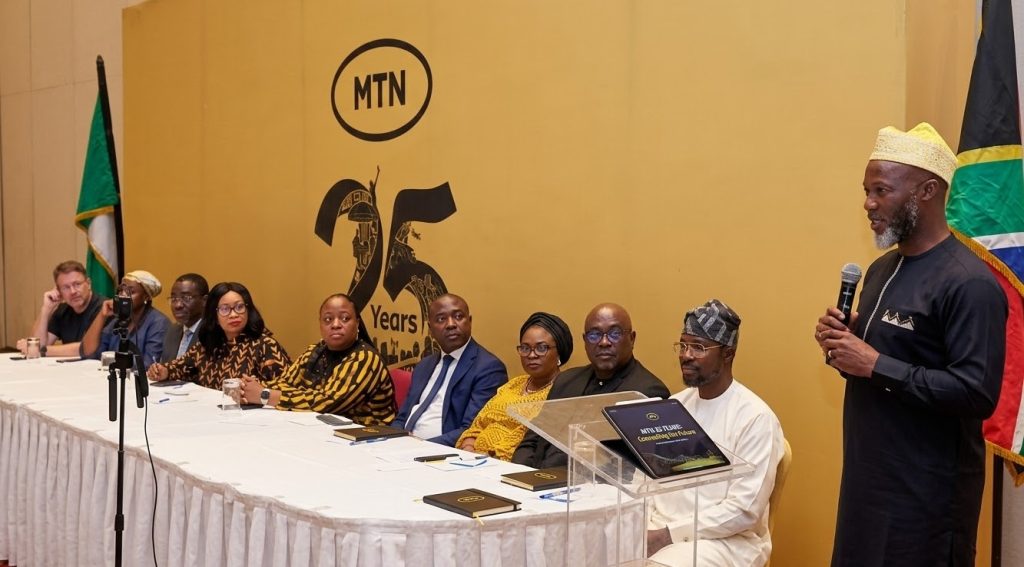
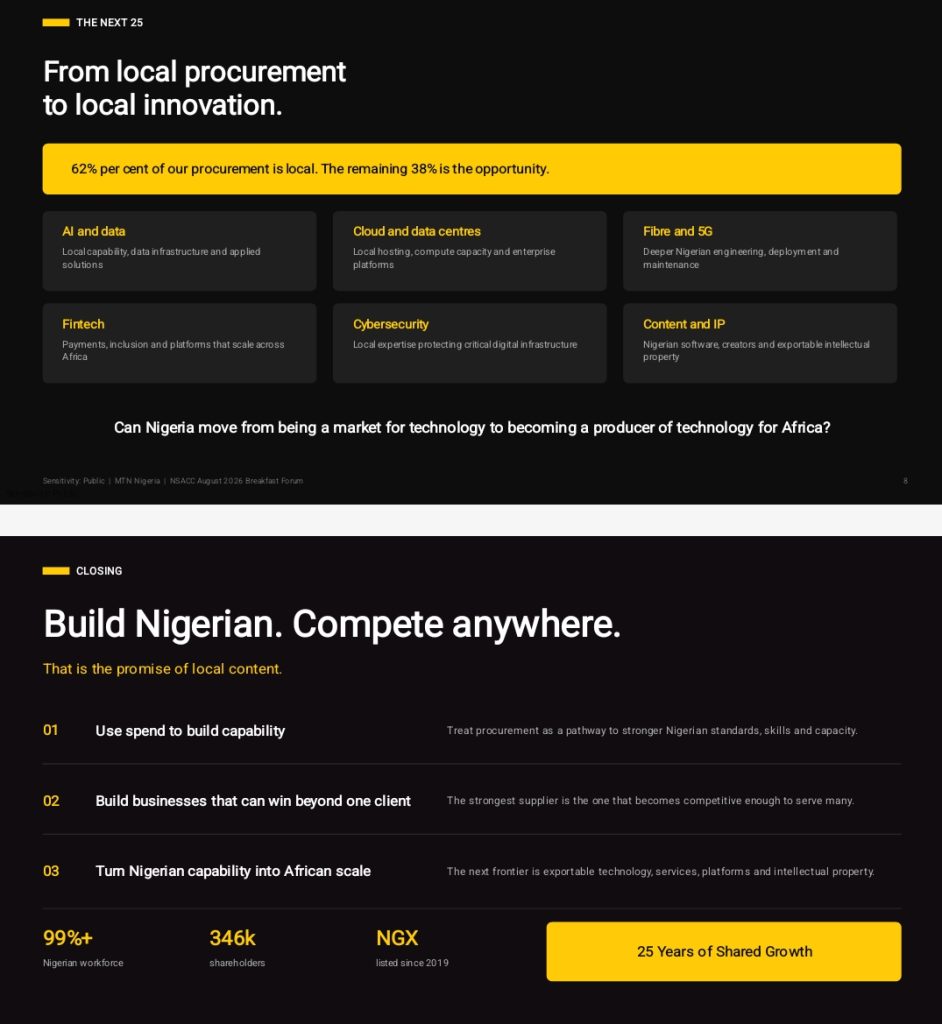
MTN Nigeria spent more than ₦2.7 trillion with Nigerian suppliers in 2025, as the company increased the share of its procurement going to local businesses to 62 per cent, its Chief Financial Officer, Modupe Kadri, has disclosed.
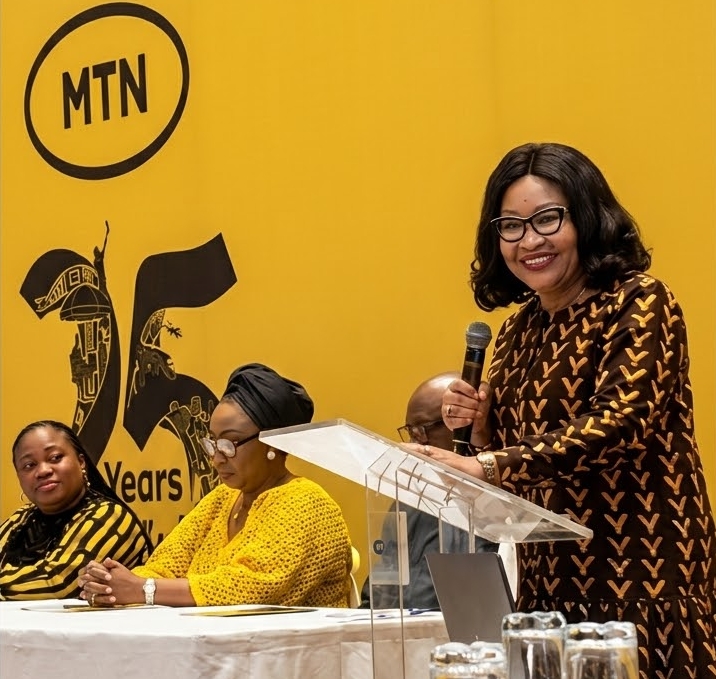
Kadri made the disclosure on Thursday 27th August 2026, at the Nigeria-South Africa Chamber of Commerce (NSACC) August Breakfast Meeting, sponsored by MTN Nigeria and held at Eko Hotel & Suites, Lagos.
The forum, themed “Building Local Content Together: 25 Years of Shared Growth,” formed part of activities marking MTN Nigeria’s 25 years of operations in the country and brought together business leaders from the advertising, manufacturing, technology and communications sectors.

Kadri said the focus of local content should go beyond the amount spent on Nigerian suppliers to what businesses are able to build from the opportunities created.
“Local procurement tells us where money was spent. Local content should tell us what that expenditure helped build,” he said.
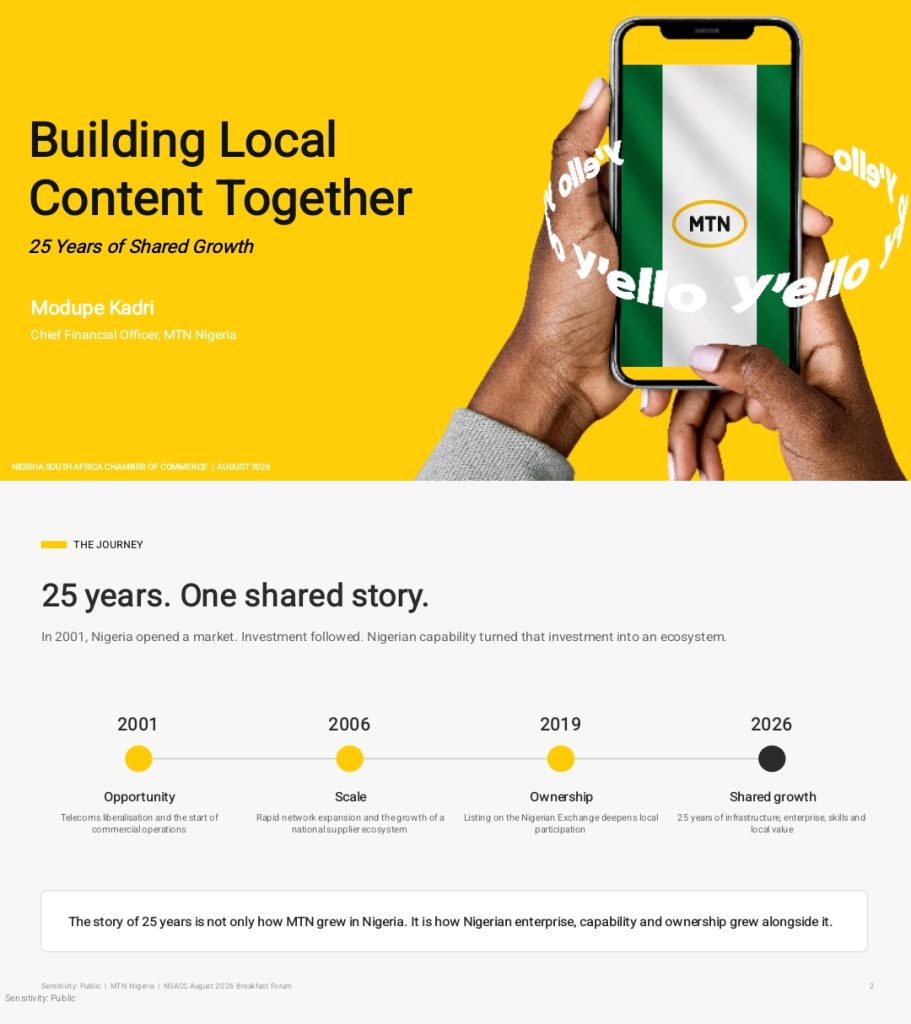
According to his presentation, MTN Nigeria increased its procurement spend with Nigerian suppliers from 59.6 per cent in 2024 to 62 per cent in 2025. The presentation also stated that MTN has contributed more than ₦7 trillion in taxes and statutory payments since inception.
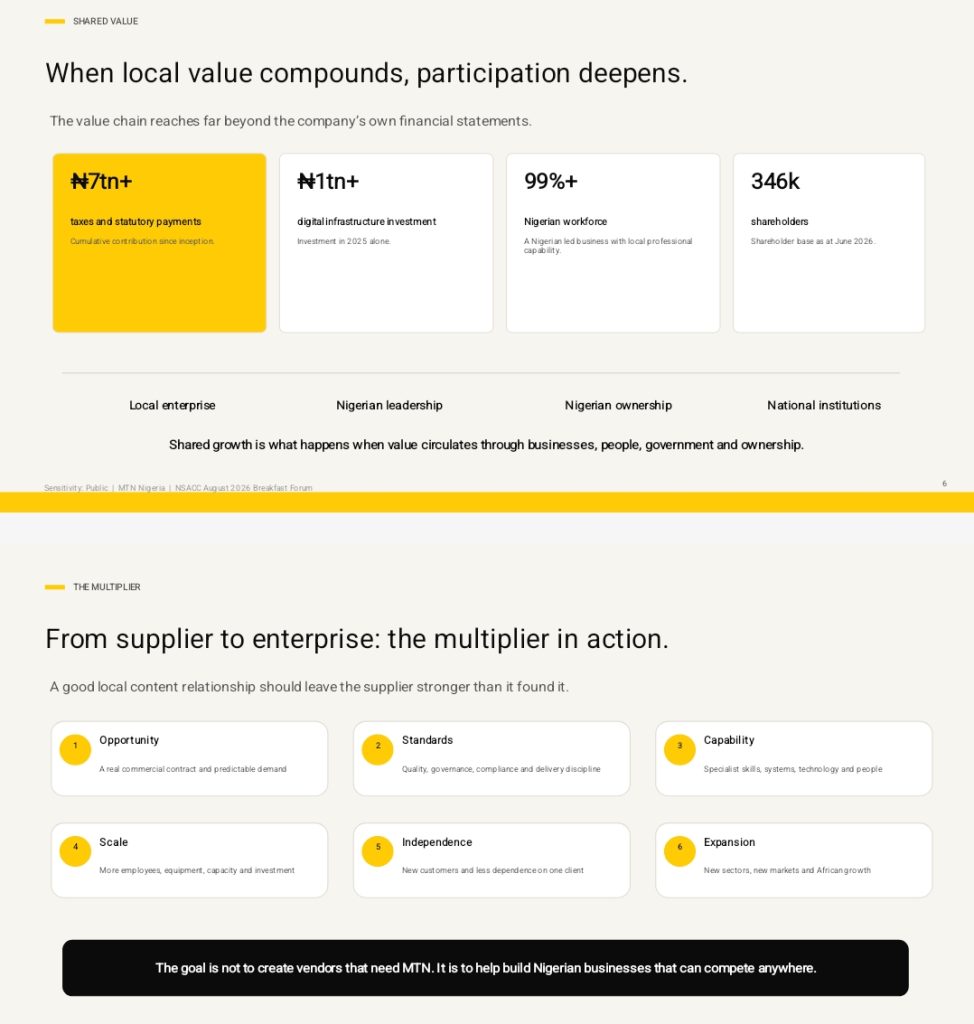
Kadri said the real test of local content was whether a supplier became stronger after delivering a contract, acquiring new skills, improving its systems, employing more people and expanding into other markets.
“The goal is not supplier dependency. It is supplier competitiveness,” he said.
Businesses that grew with MTN
For some of the business leaders on the panel, their own experiences illustrated the point.
Udeme Ufot, Group Managing Director of SO&U, said working with MTN forced his agency to improve its standards, processes and capacity.
He recalled that when SO&U returned to the MTN account, the scale of work required the agency to significantly increase its workforce.
According to him, the demands of the account ultimately strengthened the organisation’s capacity to compete at international standards.
“When you raise your game to the level that MTN demands, even when they leave, you still have it,” he said.
Yemi Chukwurah, CEO, Seams & Stitches Limited, spoke from the manufacturing perspective. She recalled starting her business from her sitting room, with her dining table serving as her cutting table. The business has since grown into a textile enterprise with more than 100 tailors and the capacity to engage up to 2,000 contract workers when demand is high.
Chukwurah urged large corporations to consider longer-term contracts and predictable order volumes as part of efforts to strengthen local manufacturing.
She said a three- or five-year contract could give manufacturers the confidence to secure financing, purchase equipment and expand their workforce.
“If I have a three-year contract or a five-year contract, and I’m taking it to my bankers, that is the kind of capacity it builds for me,” she said.
Technology capacity
For Afolabi Sobande, Group Chief Operating Officer, Computer Warehouse Group (CWG), MTN’s demands helped push the technology company beyond its earlier business model. He said CWG started its relationship with MTN in 2001, when it was largely a technology company selling computers and servers.
The experience of working on MTN’s infrastructure and meeting its delivery standards, he said, helped the company develop new capabilities and expand into other African markets.
Sobande said the next phase should focus heavily on data sovereignty, digital infrastructure and skills development, arguing that Nigeria has the talent required to build its own technology capacity if businesses are given the right opportunities and exposure.
From Nigeria to the world
For Ayeni Adekunle, Founder and CEO of Blackhouse Media, working with major brands such as MTN can provide Nigerian businesses with credibility that opens doors beyond the country. He recalled that Blackhouse media first secured the opportunity to work with MTN in 2017 after an earlier unsuccessful pitch.
The relationship, he said, became an important reference point as the company expanded its business beyond Nigeria. Blackhouse media, which started from a two-bedroom flat, now has operations in Lagos, London and Edinburgh.
Adekunle said Nigerian businesses should be ambitious about building companies capable of competing globally rather than limiting their aspirations to the domestic market.
The next 25 years
The discussion also turned to what local content should look like in the next phase of MTN’s Nigerianroid operations.
Kadri identified artificial intelligence and data, cloud and data centres, fibre and 5G, fintech, cybersecurity, content and intellectual property as areas where Nigeria could deepen local capability. He said the company was looking beyond procurement to the development of stronger Nigerian businesses.
He also noted that MTN’s Nigerian workforce is more than 99 per cent local and that the company had 346,000 shareholders as of June 2026.
The panelists agreed that the next stage of Nigeria-South Africa business cooperation should create more opportunities for local companies to develop expertise, access markets and compete across the continent.
GATMASH NEWS
…News That Drives Impact
For advert placements and business inquiries, kindly reach us via:
📧 Email: [email protected]
📞 Tel/WhatsApp: +234 (0) 807 202 2024
We value your voice! Share your stories, eyewitness reports, and contributions with us anytime:
📲 SMS/WhatsApp: +234 (0) 807 202 2024
📧 Email: [email protected]
Visit us online: https://gatmash.com